Shared article
The Enduring Paradox of Water Divining: An Examination of Practice, Belief, and Scientific Scrutiny
Introduction: The Ancient Art, Modern Skepticism
Chapter 1
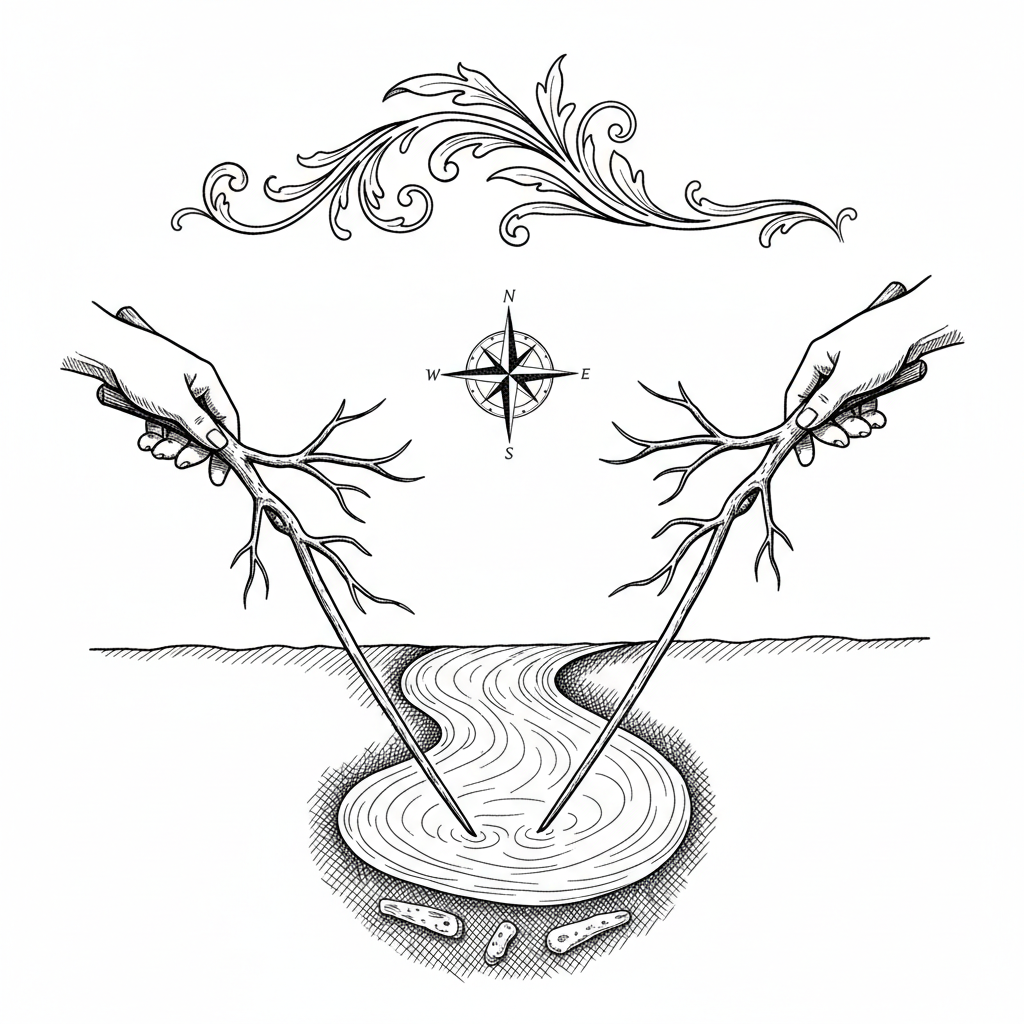
For millennia, humans have sought to uncover the hidden bounty beneath the Earth’s surface, none more vital than water. From this ancient quest arose water divining, a practice also known as dowsing or water witching. At its core, water divining involves individuals using simple tools—most commonly a forked stick or L-shaped metal rods—to detect subterranean water, minerals, or other concealed objects. The dowser walks methodically across a landscape, holding their chosen instrument, waiting for a physical reaction in the tool, such as a dip, twitch, or crossing, which is interpreted as an indication of the target's presence below.
This seemingly mystical art, rooted deeply in tradition, has been an indispensable part of human settlement and resource management across diverse cultures and historical epochs. Its enduring prevalence, however, stands in stark contrast to its contemporary scientific standing. While countless individuals and communities attest to its efficacy through anecdotal experience, modern science largely dismisses water divining as a pseudoscience, consistently failing to find empirical evidence that supports its claims beyond the realm of chance. This fundamental tension—between deep-seated belief and rigorous scientific skepticism—defines the fascinating and often contentious narrative of water divining, positioning it as an enduring paradox in the history of human endeavor and discovery. The following examination will delve into its origins, methods, the scientific explanations for its perceived effects, and the socio-cultural factors that have allowed this ancient practice to persist into the modern age.
A Legacy in Stone and Soil: Tracing Water Divining's Ancient Roots
Chapter 2
The origins of water divining are shrouded in the mists of antiquity, with tantalizing hints stretching back thousands of years. Some interpretations of 8,000-year-old cave paintings in the Tassili Caves of northern Africa depict figures holding forked sticks in what could be construed as dowsing poses, suggesting an incredibly ancient lineage. Similar imagery from ancient Egyptian and Chinese civilizations further illustrates the widespread and deep historical roots of practices resembling modern dowsing, hinting at a universal human impulse to seek hidden resources.
However, it was in 15th-century Germany that dowsing, or the use of the divining rod, truly came into prominence as a practical technique. German miners in regions like the Harz Mountains employed these rods not primarily for water, but for locating valuable metal ores such as silver, copper, and lead. This specialized application established a degree of perceived utility, making the practice an accepted, albeit controversial, part of the mining industry of the era.
As German miners migrated across Europe in the 16th and 17th centuries, they carried the practice with them, spreading its methods and mystique. It was during this period that the divining rod transitioned from primarily ore detection to a broader application, including the search for subterranean water. This diffusion eventually brought the practice to North America with European settlers, where it gained the colloquial moniker "water witching," reflecting both its perceived supernatural aspect and its practical utility in a new frontier.
Despite its widespread adoption, dowsing was not without its detractors from early on. Religious institutions, notably the Catholic Church and figures within the Protestant Reformation like Martin Luther, condemned the practice. They often associated it with divination, sorcery, or occultism, viewing it as an affront to divine providence or a pact with malevolent forces. These historical condemnations underscore the long-standing controversies surrounding the nature and legitimacy of dowsing, debates that continue, albeit in a secularized form, in the modern scientific era.
The Dowser's Instrument: Tools, Techniques, and Perceived Mechanisms
Chapter 3
The practice of water divining relies on a select range of tools, each manipulated with a specific technique, and accompanied by a set of proposed mechanisms for their efficacy, largely unsupported by conventional science. The most iconic instrument is the forked stick, traditionally cut from trees like willow, peach, hazel, or witch-hazel. The dowser grips the two prongs of the Y-shaped stick firmly, palms upwards, with the stem pointing forward and slightly upward. Another popular tool involves two L-shaped metal rods, often made of copper or steel, held loosely in each hand, parallel to the ground. Pendulums, suspended from a string or chain, represent a third category, used by some dowsers who interpret their swings or rotations as signals.
Regardless of the tool, the physical technique involves holding the chosen instrument in a state of delicate tension and balance while walking slowly over an area of interest. The dowser maintains a focused state, anticipating a physical "reaction" from the tool—the forked stick might suddenly dip or snap downward, the L-rods might cross over each other, or a pendulum might begin to swing in a particular pattern. This perceived movement is then interpreted as a positive indication of the presence of water, minerals, or whatever the dowser is seeking.
Proponents of water divining offer various explanations for these tool reactions, which often venture into speculative physics or unproven energy concepts. Common suggestions include that the tools act as amplifiers for subtle energy fields or electromagnetic signals emanating from underground resources. These hypothesized fields are believed to interact with the dowser's body, triggering an involuntary muscular response that, in turn, causes the loosely held tool to move. Some dowsers claim a more direct, almost psychic, connection to the hidden resources, with the tool merely serving as an external indicator of an internal sensation or intuition. Furthermore, a subset of dowsers assert an ability not just to locate, but also to determine characteristics like the depth of a water source or the volume of flow, often by observing the intensity or frequency of the tool's reaction, perhaps counting each "bob" of a rod as a unit of depth. These claimed abilities, while central to the practice, remain unsubstantiated by empirical observation or scientific measurement.
The Ideomotor Effect and the Scientific Lens: Explaining the Unseen Motion
Chapter 4
Mainstream science approaches the phenomenon of water divining with a critical eye, offering a robust explanation for the perceived movements of dowsing tools that does not invoke unseen energy fields or special abilities. The widely accepted scientific explanation is the ideomotor phenomenon. This involuntary, unconscious muscular action, driven by subconscious expectations or beliefs, can cause subtle, imperceptible movements in loosely held objects. When a dowser anticipates a reaction, their subconscious mind, influenced by belief and suggestion, can trigger minuscule muscle contractions in their hands and arms. These tiny movements are then amplified by the mechanical leverage of a dowsing rod or pendulum, creating the illusion that the tool is moving independently in response to an external stimulus.
This understanding has been rigorously tested through numerous controlled scientific experiments designed to eliminate bias and isolate the claimed dowsing ability. Such experiments typically involve dowsers attempting to locate hidden water pipes or containers under blinded conditions, where neither the dowser nor the experimenter knows the true locations. Overwhelmingly, the outcomes of these experiments have been consistent: dowsers' success rates are no better than random chance. They perform no better than someone guessing, fundamentally failing to demonstrate any verifiable ability to detect subterranean resources. The U.S. Geological Survey (USGS), a leading authority on Earth sciences, explicitly addresses dowsing, stating that government-funded testing is not justified. The USGS points to the lack of any scientific basis for the practice and highlights the common prevalence of groundwater in many areas, meaning that simply drilling in a random spot often yields water, which can be mistakenly attributed to successful dowsing.
The scientific community maintains that while the personal experience of dowsers is genuine—they truly feel the tool moving—the cause is internal and psychological, not an external detection of hidden resources. This distinction is crucial: the phenomenon is real, but its interpretation by dowsers is not scientifically supported. The controlled conditions of scientific inquiry, which remove contextual cues and psychological biases, reveal that dowsing does not reliably lead to discovery beyond what pure chance would predict.
A Wellspring of Necessity: Why Dowsing Persisted Through the Ages
Chapter 5
Beyond the realm of scientific validation, the enduring persistence of water divining throughout history can be attributed to a confluence of profound socio-economic, environmental, and psychological factors. Foremost among these is the historical absence of advanced hydrological survey and drilling technologies. For much of human history, locating underground water was a matter of survival, and without the sophisticated geological mapping, remote sensing, and drilling equipment available today, communities relied on empirical observation, local knowledge, and practices like dowsing to fulfill this critical need. In an era where a dry well could mean ruin or death, any method that offered hope, however unproven, was eagerly embraced.
The belief in dowsing's efficacy was further bolstered by several human cognitive biases and environmental realities. Anecdotal successes, passed down through generations, created powerful narratives that reinforced faith in the practice. Confirmation bias played a significant role; when a dowser located water, it was celebrated as proof of their ability, while failures were often rationalized or forgotten. Moreover, groundwater is naturally prevalent in many regions, often close enough to the surface that simply drilling in a somewhat random location has a high probability of success. Each such successful drilling, regardless of whether a dowser was involved, could be attributed to the dowser’s skill, further cementing belief in the community.
Economically, dowsing presented an accessible and cost-effective alternative to potentially expensive and complex modern equipment. In rural communities, financially constrained regions, or areas lacking infrastructure for advanced hydrogeological studies, hiring a local dowser was, and often still is, a far cheaper and simpler option than contracting with geological consultants and deploying specialized machinery. This economic practicality, coupled with its embeddedness in local tradition and the psychological comfort it offered in uncertain times, ensured that water divining not only emerged but also sustained its relevance across diverse cultures and across centuries, long before the advent of the scientific methods that would eventually challenge its claims.
Conflicting Evidence: Documented Successes and Skeptical Challenges
Chapter 6
The debate surrounding water divining has been punctuated by notable attempts to either validate or refute its claims, yielding findings that remain highly controversial. One of the most frequently cited instances of perceived success is a German government-funded study from the early 1990s. This research, led by physicist Professor Hans-Dieter Betz of the University of Munich, reportedly involved hundreds of dowsers across arid regions, including Sri Lanka, Kenya, and Yemen. The study claimed an "astounding success rate," reporting that dowsers achieved a 96% success rate in locating water over 691 drillings. Crucially, the study also claimed that dowsers could predict water depth and volume with an accuracy ranging from 10% to 20%. These findings, published in peer-reviewed journals, sparked considerable debate and were interpreted by proponents as powerful evidence for dowsing's efficacy, despite the broader scientific community expressing strong reservations about the methodology and potential for bias in the field conditions.
In stark contrast to such reports are the rigorous skeptical challenges mounted by figures like the late magician James Randi. A vocal critic of pseudoscience, Randi famously offered a substantial prize—originally $10,000, eventually growing to $1 million—to anyone who could demonstrate a paranormal ability, including dowsing, under scientifically controlled conditions. Over decades, numerous dowsers attempted to claim the prize, but none succeeded. In typical challenges, dowsers were asked to locate water flowing through hidden pipes or tanks, with careful measures taken to prevent any sensory cues. Consistently, dowsers failed to perform better than random chance, leading Randi to conclude that dowsing lacked any genuine basis. These high-stakes challenges have become a touchstone for scientific skepticism, powerfully illustrating the disconnect between anecdotal claims and empirical evidence.
The modern skepticism embodied by Randi has historical precedents. As early as the 16th century, Georg Agricola, the "Father of Mineralogy," criticized the use of the divining rod in his seminal work on mining, *De Re Metallica*, dismissing it as superstitious. Similarly, religious reformers like Martin Luther condemned dowsing, viewing it as a pagan or occult practice. These historical and modern challenges highlight a continuous thread of rational inquiry and skepticism directed at dowsing, underscoring the enduring nature of the debate between those who believe in its power and those who demand empirical proof.
Dowsing in the 21st Century: Cultural Legacy, Economic Niche, and Modern Alternatives
Chapter 7
In the 21st century, despite the overwhelming scientific consensus against its validity, water divining persists, occupying a fascinating niche between cultural legacy and economic expediency. The practice continues to be relevant and actively employed in many rural communities, particularly in developing regions, where access to advanced technology and hydrogeological expertise is limited. In parts of Africa, for instance, dowsing retains significant cultural significance and trust, often serving as a community-driven method for locating critical water sources. Its accessibility, requiring only simple tools and perceived innate skill, makes it a practical solution where modern alternatives are either unaffordable or unavailable.
The utility of dowsing stands in stark contrast to the sophisticated capabilities of modern hydrogeological survey techniques. Contemporary methods involve capital-intensive equipment and specialized technical expertise, offering significantly higher accuracy and reliability. Techniques such as electrical resistivity tomography (ERT), seismic refraction, and ground-penetrating radar (GPR) utilize principles of geophysics to map subsurface structures, identify aquifers, and estimate water yields with precision. These methods provide quantitative data, allowing for informed decisions regarding well placement, depth, and expected output, thereby minimizing the risk of drilling costly dry holes.
Yet, despite the undeniable advantages of scientific methods, dowsing has not faded entirely. Advertisements for dowsing services can still be found in local media in various parts of the world, and organizations such as the American Society of Dowsers continue to exist, promoting the practice through workshops and conferences. This persistence reflects not only a lingering cultural attachment to traditional methods but also an economic niche where the perceived low cost and simplicity of dowsing continue to appeal, particularly to individuals or small communities facing financial constraints or a distrust of complex, high-tech solutions. It endures as a testament to the powerful influence of tradition and belief, even in an age dominated by scientific advancements.
Conclusion: The Enduring Paradox of Water Divining
Chapter 8
The journey through the history and contemporary status of water divining reveals a practice steeped in paradox. It is a testament to humanity's ancient quest for vital resources, a tradition that has spanned millennia and permeated diverse cultures, offering hope and apparent solutions in times of great need. Yet, concurrently, it represents a profound challenge to modern scientific understanding, as its core claims consistently fail to withstand rigorous empirical scrutiny.
The enduring legacy of water divining is thus a dual narrative: one of historical significance and deeply held anecdotal belief, and another of consistent scientific dismissal. The movements of dowsing tools, so confidently interpreted by practitioners, are largely explained by the ideomotor effect—unconscious muscular responses driven by subconscious expectation. This psychological phenomenon, coupled with the natural prevalence of groundwater in many regions and the pervasive influence of confirmation bias, creates a compelling illusion of efficacy that reinforces belief, even in the absence of external evidence.
In the end, water divining embodies a broader tension between tradition, intuition, and scientific understanding. Its continued practice, even in the face of advanced hydrogeological alternatives, underscores the complex nature of human belief and the powerful draw of methods that are accessible, low-cost, and resonate with established cultural narratives. While science offers objective, verifiable means of discovery, the enduring appeal of dowsing highlights the human desire for simple, intuitive solutions and the challenge of fully displacing ancient practices, even when confronted by the precision and reliability of modern rational inquiry. The paradox of water divining endures, a vivid illustration of where the certainty of science meets the resilience of human faith and tradition.
Bibliography
- farmersalmanac.com. Source
- historicunioncounty.com. Source
- westcoastplacer.com. Source
- icysedgwick.com. Source
- dowsing-research.net. Source
- primalwater.com.au. Source
- amazinggemstone.com. Source
- hrecos.org. Source
- usgs.gov. Source
- wikipedia.org. Source
- byu.edu. Source
- appalachianhistory.net. Source
- aquaboredrilling.com.au. Source
- modernfarmer.com. Source
- blackflash.ca. Source
- hobbyfarms.com. Source
- youtube.com. Source
- plusvalueindia.com. Source
- groundwateruk.org. Source
- equip.org. Source
- wtamu.edu. Source
- wefindwater.com. Source
- uh.edu. Source
- quora.com. Source
- trafficinfratech.com. Source
- waterdiviningnamibia.com. Source