Shared article
Smoke and Symbol: The Engineering, Culture, and Contradiction of the Western Fireplace
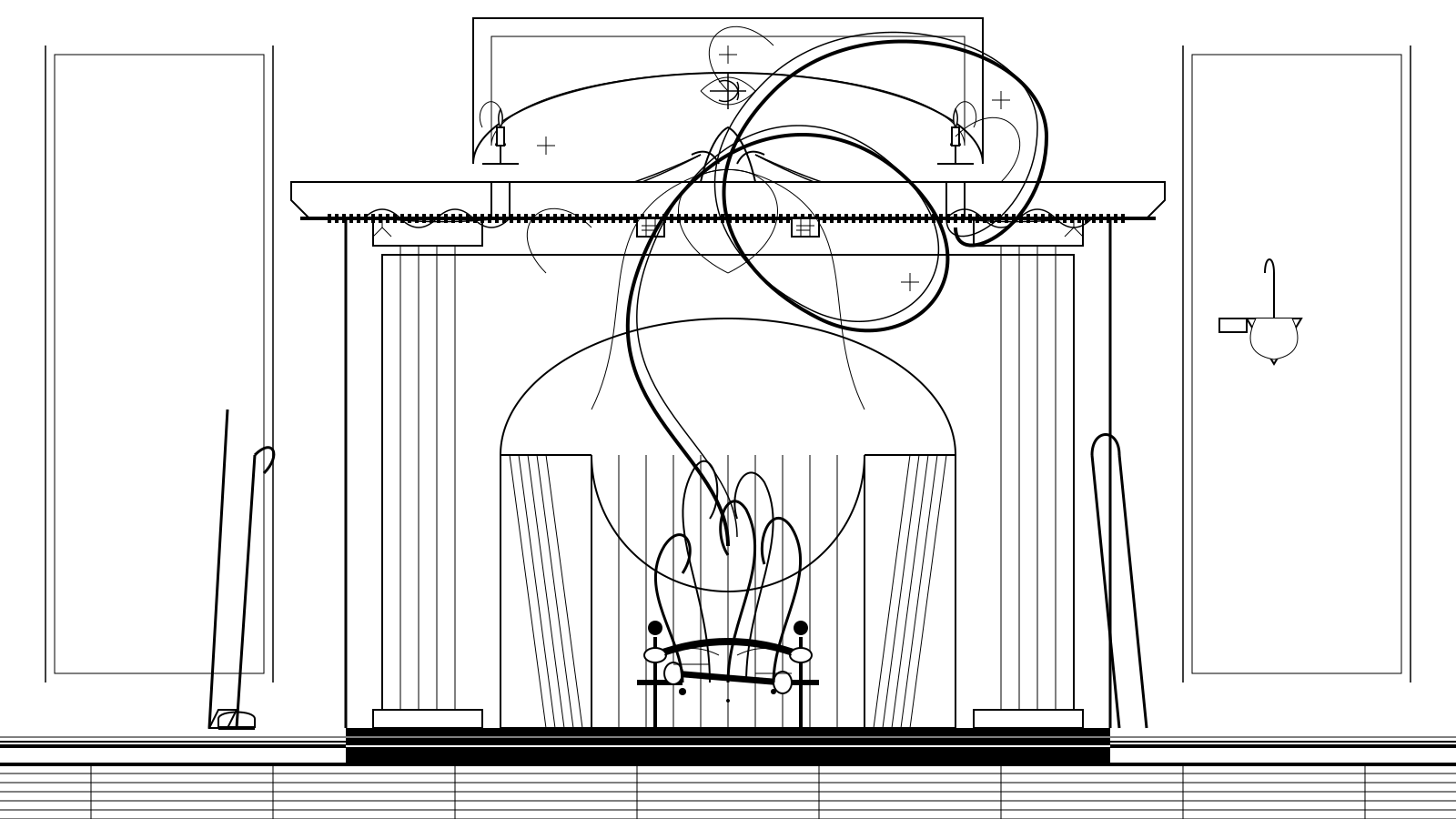
Introduction: The Hearth Paradox
Chapter 1
Walk into any new suburban development and you are likely to find them: hearths crafted of stacked stone, gas flames dancing behind tempered glass, standing as the undisputed focal point of the great room. The National Association of Home Builders consistently finds a fireplace among the top three most desired features for prospective buyers. The United States Energy Information Administration confirms that over forty percent of American homes possess one. Yet, from a strict thermodynamic perspective, an open fireplace is a disaster. It sucks heated room air up the chimney, performs at a pitifully low efficiency, and does little more than warm the feet of those sitting directly in front of it.
Why do we cling so tenaciously to such a flawed machine? The obvious answer—that it makes a home feel cozier—only pushes the question back a step. Why does a smoky, inefficient hole in the wall feel cozy at all? The entire history of the Western fireplace is the story of this very paradox: a perpetual negotiation between the grim calculus of survival and the deep, stubborn pull of cultural symbolism. It is a history of engineers and architects trying to solve the smoke problem, the heat problem, and the fuel problem, only to find that the human heart keeps demanding something older, messier, and far less perfect.
The Smoke-Filled Hall: The Medieval Open Hearth and the Chimney Revolution
Chapter 2
For the better part of a millennium, the heart of the Western domestic building was defined by its failure to control smoke. The medieval great hall, a vast communal space of stone and timber, was organized around an open central hearth. The fire was a literal necessity for warmth and cooking, but its byproduct—acrid, choking smoke—dictated the entire architecture of the room. The smoke coiled against the high ceilings, staining the rafters black before escaping through a louvered opening in the roof. The building was less a shelter from the elements than a carefully engineered vessel for managing aerodynamics. This arrangement had profound social consequences. Because the fire was in the center, the room had to be tall to avoid the worst of the smoke, and it was fundamentally a single, public space.
The development of the braced wall fireplace and its associated chimney, which began to appear in the 12th and 13th centuries, was thus nothing less than a spatial and thermal revolution. It was a leap as profound as the invention of the window. The chimney created a negative pressure draft that actively drew smoke out of the living space, allowing the fire to be pushed against an exterior wall. This single innovation freed the floor plan completely. Builders could now stack rooms vertically, creating the multi-story home. The lord could have a private solar, or withdrawing room, warmed by its own fire. The fireplace itself became an architectonic anchor—the hearth, the massive stone or brick surround, and the rising mass of the flue came to dictate the layout of the room, creating a magnetic center for furniture and social life. The hearth was no longer just a source of heat; it was the structural and symbolic spine of the house.
Franklin, Rumford, and the Science of the Fire
Chapter 3
For centuries, the fireplace provided heat in the crudest possible way: a large volume of burning wood radiating energy in all directions, with much of that heat lost up the chimney. It was not until the Enlightenment that rigorous scientific minds turned their attention to this domestic problem. Benjamin Franklin, ever the pragmatist, was deeply frustrated by the cold drafts and wasteful inefficiency of the traditional Boston fireplace. In 1744, he unveiled his Pennsylvania Fireplace, a cast-iron insert that was, in essence, a stove masquerading as a fireplace. Its genius lay in a separate air duct that drew cold air from outside, warmed it against the hot iron of the firebox, and then released it into the room. This was a crucial step toward controlling the thermodynamics of the fire, even if the design was ultimately too complex to dominate the market.
It was the work of another figure that truly perfected the science. In 1796, Sir Benjamin Thompson, Count Rumford, an American-born British physicist and diplomat, published his analysis of fireplaces. Rumford understood something his predecessors had missed: radiant heat is the only heat that truly matters for human comfort. An open fireplace heats almost exclusively by radiation, warming bodies and solid surfaces directly rather than the air itself. His design was a masterpiece of applied physics. He made the firebox shallow, so the fire was close to the room. He made it tall, so the radiant surface was large. He angled the side walls inward, reflecting more heat outward. And most critically, he narrowed the throat of the chimney, creating a smooth, aerodynamic path for the smoke that massively reduced the amount of warm room air sucked out with the exhaust. The combination of these refinements doubled the usable radiant efficiency of the fireplace from roughly fifteen percent to an extraordinary thirty percent. The Rumford fireplace became the global standard for the next two hundred years, a testament to the power of understanding the fundamental physics of a fire.
The Mass-Produced Hearth: The Industrial Revolution Democratizes Heat
Chapter 4
The elegant efficiency of the Rumford fireplace arrived just in time for a profound shift in the fuel supply. For centuries, Western civilization had been built on wood. By the late 18th and early 19th centuries, wood was becoming scarce and expensive around industrializing cities. The answer was coal, a denser, hotter fuel that redefined the mechanics of the hearth. Coal required a grate to allow air to flow up through the fuel bed, a significant departure from the wood fire built directly on andirons. The Industrial Revolution provided the perfect manufacturing process for this new era of heating: cast iron. Iron foundries could now produce intricate, affordable grates, firebacks, and hob grates in vast quantities. The fireplace was no longer a bespoke piece of masonry hand-carved by a local mason. It was a standardized, purchasable commodity.
This was the era that codified the modern mantelpiece. The Victorians, with their intense love of domestic ritual and ornate display, transformed the mantel into the central shrine of the home. It was a stage for the family clock, vases, photographs, and bric-a-brac. The very act of gathering around the fire, in a parlor now specifically designed for that purpose, became the defining social ritual of the 19th-century middle class. A fireplace was no longer just a mechanical necessity; it was proof that a family had achieved a certain standard of domestic respectability. By the end of the century, the hearth was no longer a luxury of the rich. It was a near-universal feature of the Western home, an assumed part of the architecture of domestic life, deeply embedded in the expectations of what a real home should contain.
The Warm Glow of Obsolescence: Central Heating and the Birth of the Symbolic Fire
Chapter 5
The twentieth century delivered the most existential threat the hearth had ever faced: the complete and total outsourcing of its primary function. The development of the forced-air furnace, the radiator, and the electric baseboard heater—controlled by the effortless interface of the thermostat—turned heating from a room-by-room chore into an invisible, automated system. A fireplace was now, strictly speaking, unnecessary for survival. You could live an entire winter in perfect comfort without ever lighting a match.
And yet, the hearth did not disappear. Instead, it performed a breathtaking act of reinvention. Shedding its primary function as a survival tool, it leaned entirely into its secondary ones. It became a pure symbol. Architectural critics have noted this as the shift from the hearth to the home. The fireplace survived because it was the nostalgic heart of the house, a visual and emotional connection to a pre-industrial past that felt increasingly lost in the age of the thermostat and the fluorescent light. The gas log set, and later the gas direct-vent fireplace, commercialized this aesthetic desire perfectly. They offered the look of a fire—the dancing flame, the comforting glow—without any of the work of wood. There was no ash to clean, no log to split, no draft to balance. This was the fireplace as pure theater, an appliance designed to satisfy the emotional and ritualistic needs of the occupant while the furnace silently handled the thermodynamics.
The Efficiency Imperative: EPA Regulations and the Modern Fireplace Crisis
Chapter 6
The cozy romance of the open fire came under a new kind of assault in the late 20th and early 21st centuries, this time not from a scarcity of fuel, but from a surplus of environmental science. The problem with a wood fire is not just its abysmal heating efficiency, but its emissions. A traditional open fireplace is a profoundly dirty machine, pumping fine particulate matter—PM2.5—directly into the atmosphere, where it contributes to respiratory illness and air pollution. In 2015, the U.S. Environmental Protection Agency updated its New Source Performance Standards for wood heaters, culminating in the 2020 standards that mandated an approximately 80% reduction in PM2.5 emissions compared to older models. In many jurisdictions, this effectively outlawed the traditional open wood fireplace in new construction.
The market has responded with a suite of engineering solutions that represent the definitive modern state of the art. On one side, there is the modern wood stove. Certified by the EPA, these units employ either catalytic combustors or secondary combustion chambers that re-burn the smoke and gases before they can escape up the flue. They achieve efficiencies of 70 to 80 percent and burn exceptionally cleanly. But they are stoves, not fireplaces. The fire is trapped behind a glass door, and the nature of the gathering changes. On the other side is the high-efficiency gas direct-vent fireplace. It can reach efficiencies of up to 85 percent, can be controlled with a remote, and requires no chimney sweep. The central tradeoff sharpens into a stark choice: open fires offer the highest emotional authenticity and the lowest efficiency, while modern inserts are highly efficient but can feel distinctly like appliances. This is the definitive modern crisis of the hearth: a choice between the soul of the fire and the logic of the machine.
The Unquenchable Prospect: The Hearth in a Hyper-Efficient Age
Chapter 7
The journey of the fireplace from the smoke-filled hall to the living-room feature wall is an object lesson in technological determinism hitting a wall. We have completely solved the smoke problem and the efficiency problem. We can burn a fire so cleanly that no exhaust is vented, using bioethanol. We can simulate a flame with such fidelity using LEDs and water vapor that it is almost impossible to distinguish from the real thing. And yet, the soul problem remains stubbornly tied to older, more imperfect forms.
The rise of the outdoor fireplace and the fire pit over the last two decades is a fascinating symptom of this enduring need. When the indoor hearth became regulated and compromised by emission controls and efficiency mandates, the fire simply moved back outside, returning to its most primal, uncontained form. The market for bioethanol fireplaces, which produce real flames but no venting, is another attempt to have the symbolic truth of fire without any of its architectural or environmental baggage. These are not engineering triumphs; they are psychological ones. What the history of the fireplace ultimately reveals is that humans do not just heat their homes. They inhabit them. Part of inhabiting a space is having a dynamic, tangible focal point for gathering—a connection to the material world that the perfectly controlled, sealed environment of modern life tends to erase. The fireplace, in all its flawed and inefficient glory, provides that friction.
Conclusion: The Fire Inside the Machine
Chapter 8
The history of the Western fireplace is a history of optimization bumping up against the stubborn constraints of human emotion and ritual. We have tried to make it safer, cleaner, more efficient, and more automated. With every rational improvement, we have had to confront the fact that the most efficient fireplace is not the most desired one, and the most authentic one is not the most practical. This contradiction is not a bug in the product; it is the engine of its entire cultural history.
The fireplace persists because in a world of perfect, invisible climate control, it remains a stubborn, visible, and voluntary engagement with the elements. Lighting a fire is a small act of mastery—gathering the fuel, arranging the kindling, applying the match. It is also an act of surrender—to the draft, to the smoke, to the unpredictable dance of the flame. It is a ritual that connects us to the millennia of human experience that preceded the furnace and the thermostat. We do not keep fireplaces because they are good tools. We keep them because they are good rituals. The fire inside the machine is a reminder that we are not quite at home in a perfectly sealed, thermally efficient world. We still want the heat on our face and the ancient, flickering light in our eyes.