Shared article
How a Household Broom Became the Witch’s Vehicle
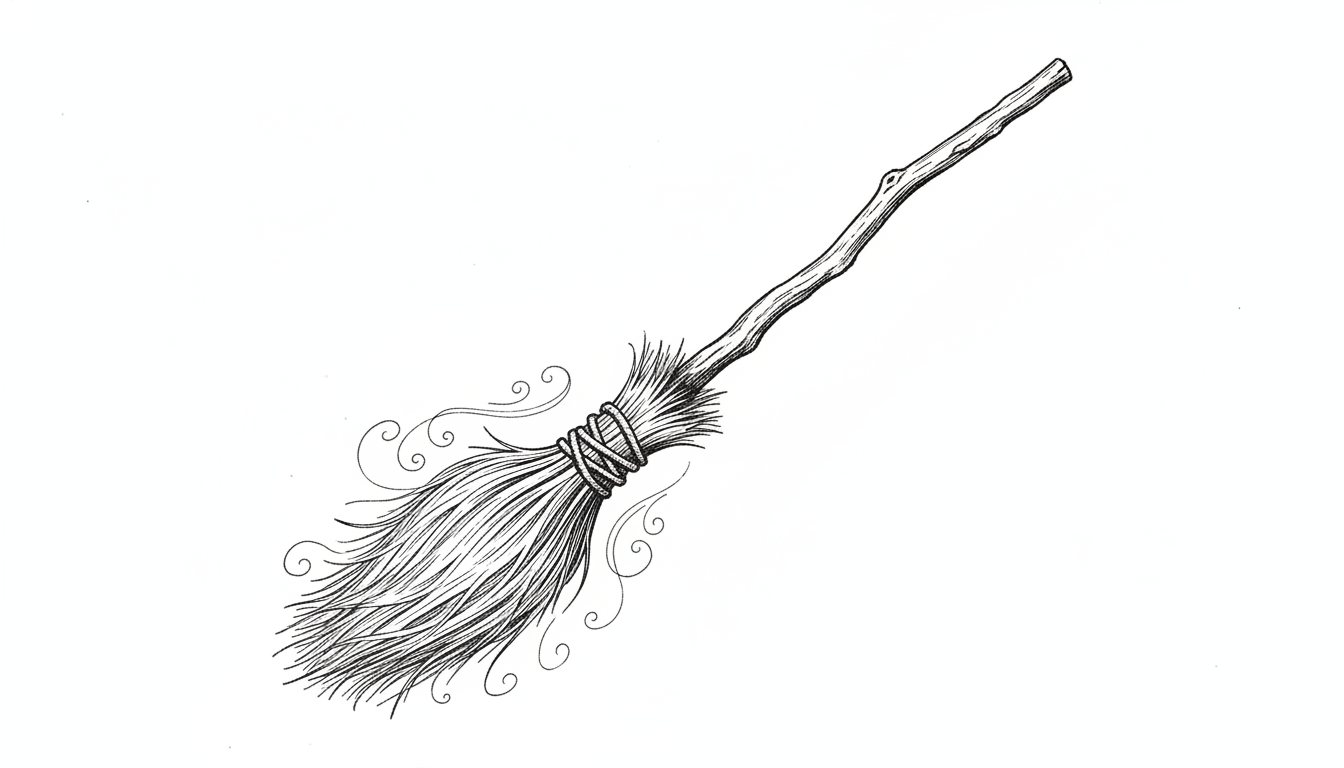
The First Broom Was Not Yet a Broomstick
Chapter 1
The familiar witch does not merely fly; she rides. Usually imagined as an old woman in a pointed hat, she sits astride a broomstick and travels through the air. That ordinary household tool now seems inseparable from witchcraft, but the pairing was not invented all at once. It formed from several stories about sorcery, bodily experience, legal accusation, and women’s domestic work.
One of the earliest documented cases linking an accused witch with an ointment is the 1324 trial of Lady Alice Kyteler, a wealthy Irish widow accused of sorcery and heresy. Authorities reported finding a pipe of ointment in her house. In the account of the case, the substance was applied to a staff, which Kyteler supposedly rode like a horse, “ambling and galloping” on it.
That detail is striking because it contains the later image in unfinished form. There is an accused woman, a substance associated with extraordinary powers, and a household-scale implement treated as a means of transport. Yet the report names a staff, not the bristled broomstick of the familiar caricature. It also belongs to a legal record intended to establish sorcery, not to a finished popular image.
Earlier folklore likewise gave magical travelers varied means of movement, including household objects and pitchforks. The question, then, is not simply why witches were imagined as flying. It is how an ointment and a staff in a medieval accusation became the instantly legible picture of a woman riding a broom through the sky. The answer begins with what the ointment could make a person feel.
When an Ointment Became a Feeling of Flight
Chapter 2
The ointment supplied a possible bridge between bodily experience and a story of supernatural movement. Accounts of so-called flying ointments describe preparations made from hallucinogenic plants and applied to the body. Afterward, a subject might experience a sensation of flying or floating. That perception was not proof that the body had left the ground, but it could later be narrated as aerial travel.
The sequence matters. An ointment was first associated with magical practice; an altered sensation followed; then observers, storytellers, or authorities could translate that sensation into a literal account of transport. What began as a feeling became a claim about an action. “Flight” therefore did not need to start as a technical description of someone physically traveling overhead. It could be the language applied afterward to an extraordinary sensation.
The staff in the Kyteler case gave that sensation a visible means of movement. The ointment was said to be applied to the staff, and the staff was treated as something that could be ridden. The report joined three elements: a magical preparation, a person sitting astride an implement, and an action described as travel.
That combination does not independently establish that the staff functioned as a flying machine. Its importance is interpretive. Within the accusation, the implement made an unusual experience legible as transport. The ointment supplied the imagined power; the staff gave the claim a recognizable shape.
This distinction between perceived and physical flight helps explain how later accounts could sound concrete even when their foundations included altered sensations or the interpretation of a reported practice. Once an experience had been given a rider, an implement, and a destination, it could be entered into a more definite story. The next step was not technological but institutional: interrogation could turn that story into a confession.
How Interrogation Turned Flight Into a Broom-Riding Confession
Chapter 3
Legal interrogation gave the story a more definite shape. An ointment might be understood as a preparation, a ritual, or the source of an unusual sensation. Under accusation, questions could organize sorcery into deliberate acts: what had been applied, what had been ridden, and where had the accused gone? The language of transport turned diffuse suspicion into a confession that could be entered into a record.
Guillaume Edelin provides a specific example. A priest from Saint-Germain-en-Laye, he was interrogated for witchcraft in 1453 and confessed to flying on a broomstick. The proceedings involved torture, so the confession is a legal statement produced under coercive circumstances, not independent confirmation that Edelin had physically flown. Its importance lies elsewhere: the record names the broomstick directly and presents riding it as part of the alleged offense.
Demonology then gave such accounts a larger framework. This literature described the nature, methods, and supposed organization of witchcraft, connecting flight with travel to illicit gatherings commonly called sabbats. The Malleus Maleficarum, first published in 1486, treated flight as a central means by which witches reached those gatherings. The broom was no longer merely linked to an ointment; it belonged to a theory of collective diabolical activity.
The theory did not erase disagreement. Johannes Nider, whose fifteenth-century writing contributed to the developing discussion of witchcraft, was not uniformly credulous about reports of witch flight. Some authorities accepted them as physical events, while others questioned whether they were imaginary. That split shows how the tradition could demand a stable account of witchcraft while disputing what the accused had actually experienced.
Still, the narrative had changed. Interrogation made the claim specific, and demonology made it repeatable. A suspected witch could now be represented as someone who traveled deliberately to a prohibited gathering and joined a larger diabolical conspiracy. What remained uncertain in prose was ready to become unmistakable in pictures.
The Moment Broom Flight Became Visible
Chapter 4
The transition from written accusation to visual convention appears in Martin Le Franc’s Le Champion des Dames, a manuscript from 1451. Its images show two women in flight: one rides a broomstick, while the other rides a simple stick without bristles. The comparison matters. It shows that artists already recognized the broom as a possible means of female magical flight, but it also shows that the choice was not yet exclusive.
The plain stick preserves the motif’s earlier flexibility. A staff, stick, broom, or other implement could give visible form to a story of movement. The broom’s presence therefore marks a stage of selection, not the instant creation of a finished icon. Its bristles identify it as a household broom, while the riding posture connects that familiar tool to the older language of magical transport.
The manuscript changed what a viewer had to know. A legal record could describe an action, and a demonological text could explain it, but an image made the claim immediately apprehensible. Viewers did not need to know about an ointment, an interrogation, or arguments over whether flight was physical. The picture supplied the shorthand: women associated with forbidden powers, carried away on implements beneath them.
Circulation strengthened the shorthand. Early woodcut illustrations, including those associated with Le Champion des Dames, carried the witch-and-broom pairing beyond a single manuscript or case. Repeated images did not have to reproduce one identical design. Each pairing made the relationship easier to recognize, allowing the broom to stand for a claim that had once required explanation.
The surviving scene also rules out a simple origin story. Broom flight was visible by 1451, yet the plain stick remained beside it. Early visual culture was helping to select one possibility from several. As texts and images repeatedly placed women, magical flight, and domestic-looking implements together, the broom gained an advantage: it required the least explanation. Its durability depended on what it already meant in ordinary life.
Why the Broom Fit the Female Witch
Chapter 5
The broom’s eventual dominance was not arbitrary. In medieval Europe it was a common domestic object directly associated with women’s household labor. That familiarity gave it unusual symbolic efficiency. A wolf or another animal could suggest wildness or supernatural power; a pitchfork could evoke a different tool; a plain staff could serve as a generic support. A broom brought the household into the picture immediately.
Earlier accounts of magical travel used varied implements, including household objects and pitchforks, while other traditions attached supernatural movement to more specialized or animal-associated forms. Nothing about the broom’s physical shape made it inevitable. Its success came from its place in everyday work. Set beneath an accused woman, it converted an ordinary activity into a sign of occult capacity.
That conversion gained force as witch-hunting literature increasingly targeted women. The broom connected the alleged crime to the labor assigned to them: cleaning, maintaining, and managing the household. In the polemical logic of the period, the domestic sphere could be presented as a place where recipes, ointments, and rituals were prepared. The tool of that sphere could then be recoded as an instrument of diabolical flight.
The symbolism worked in both directions. The rider was increasingly imagined as female, and the means of transport carried the mark of work culturally associated with women. The result was more than a strange way to travel. It suggested that familiar female tasks might conceal disorder, illicit knowledge, or an alliance with the devil. The broom became incriminating precisely because it was ordinary.
Printing and repeated illustration helped preserve the association. When a broom appeared again and again beneath a female figure identified with witchcraft, it acquired a meaning beyond practical use. It became shorthand for an alleged movement from household activity to ritual transgression. The image could make a social judgment look like a visual fact: woman, broom, and flight seemed to belong together.
The caricature endured because it compressed an accusation into a familiar tool. The broom was not selected for exotic power but for its proximity to women’s daily labor. That domesticity allowed a household implement to be presented as evidence of a hidden, diabolical life.
A Caricature Built in Several Stages
Chapter 6
The witch on a broomstick emerged through cumulative recoding, not a single act of invention. In the 1324 Kyteler record, an ointment was applied to a staff that the accused supposedly rode. Accounts associated with flying ointments supplied a possible basis for sensations of floating or flight. Interrogation, as in Guillaume Edelin’s 1453 confession, turned that possibility into a named legal statement, although coercion makes the confession unreliable as proof of an event. Demonology then placed flight within a larger account of witches traveling to sabbats, even as writers disagreed about whether such travel was physical or imaginary.
Visual culture made the claim instantly readable. Le Champion des Dames showed a woman flying on a broom as well as another on a plain stick, preserving variation while making the broom recognizable. Repeated images gradually favored it because it was not an obscure magical artifact. It was a household tool associated with women’s labor, ready to carry a second meaning.
That meaning was accusatory. The broom linked domestic work to alleged occult practice and made ordinary female life appear capable of producing diabolical disorder. Reports of sensation supplied the possibility of flight; interrogation supplied the confession; demonology supplied the destination; images supplied the lasting shorthand. The broomstick became the vehicle of the female witch when an ordinary implement was made to look like evidence of a hidden crime.
Bibliography
- Why Do Witches Ride Brooms? The History Behind the Legend | HISTORY. https://www.history.com/articles/why-witches-fly-on-brooms
- Why do witches fly on brooms? – C. W. Clayton. https://cwclaytonauthor.co.uk/2025/09/22/why-do-witches-fly-on-brooms/
- The sorcery trial of Alice Kyteler : a contemporary account (1324) together with related documents in English translation with introduction and notes : Ledrede, Richard de, -1360 : Free Download, Borrow, and Streaming : Internet Archive. https://archive.org/details/sorcerytrialofal0000ledr
- University of Glasgow - MyGlasgow - Archives & Special Collections - Digitised collections - Damned Art - Germany, Switzerland and the Low Countries. https://www.gla.ac.uk/myglasgow/archivespecialcollections/digitisedcollections/damnedart/germanyswitzerlandandthelowcountries/
- The History of the Witch's Hat and Broom - 13 Society. https://13society.com/the-history-of-the-witchs-hat-and-broom/
- The Witch’s Broom. https://sharonwray.com/folklore-legends/the-witchs-broom/
- How broomsticks, cauldrons, and pointy hats became essential witch gear | National Geographic. https://www.nationalgeographic.com/history/article/witches-gear-broomstick-hat
- Flying Ointment - Monstrous.com. https://www.monstrous.com/flying-ointment/