Shared article
How Graphite Became a Standardized Pencil Core
The Mineral That Was Almost Too Useful to Use
Chapter 1
A pencil seems to begin with a simple bargain: graphite leaves a dark mark with little effort. But the familiar wooden pencil became possible only after makers solved a stubborn problem. The mineral was useful precisely because it was soft enough to leave material on paper—and that softness also made it brittle, difficult to handle, and unsuitable as a dependable stick.
Around 1564, a major deposit was discovered at Borrowdale in Cumbria, England. Its unusually pure graphite could be sawn into solid sticks and soon found uses beyond writing. Farmers marked sheep with it, and industry used it to line cannon molds. The deposit became associated with the early English pencil and with the material then commonly called plumbago, or “lead-like,” even though graphite is carbon rather than lead.
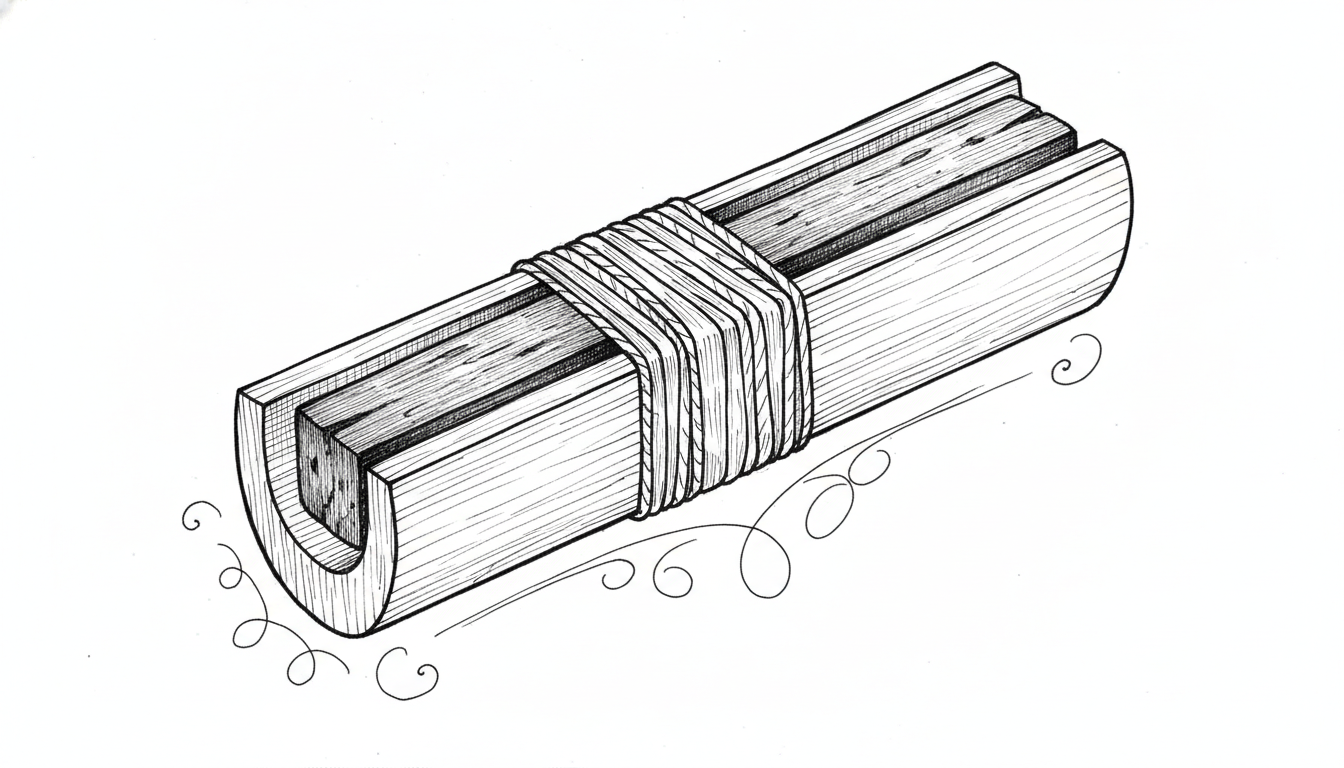
Borrowdale graphite still needed a holder. Users wrapped pieces in string or placed them in hollowed wooden sticks. Access to the mineral was limited as well: the mines were guarded, smuggling occurred, and recorded extraction at the Seathwaite Wad mines extends mainly from 1580 to 1865. A writing tool dependent on such a scarce, tightly controlled resource could not easily become inexpensive or uniform.
That contradiction gives the pencil its central story. Graphite marked paper effectively, but naturally coherent pieces were fragile, and powdered graphite was not yet a practical substitute. The breakthrough came when makers stopped treating graphite as a finished stick and began using it as an ingredient in a manufactured core.
Conté Turns Graphite Powder into a Core
Chapter 2
The breakthrough came from Nicolas-Jacques Conté, a French engineer and chemist. When access to English graphite was halted, France could no longer rely on imported high-quality material. Earlier attempts to make sticks from powdered graphite had proved impractical. Conté addressed the problem at its source: graphite did not have to be mined in naturally coherent pieces if powder could be made into a solid rod.
In 1795, Conté patented a process that mixed powdered graphite and clay in water, creating a slurry. The mixture was formed into sticks and hardened in a kiln. Each step had a distinct job. Water brought the fine particles together; forming gave them the shape of a pencil core; kiln hardening turned the shaped mass into a usable writing element.
The kiln, then, was not merely drying a wet mixture. It completed the conversion of loose graphite powder into a solid, handleable rod. Manufacturers could work with graphite that was not available as one piece suitable for sawing. The pencil core became a manufactured graphite-clay composite instead of a protected fragment of a mine.
The new rod still needed a casing, and accounts describe the material being pressed between wooden half-cylinders before the fired lead was encased in wood. But the division of labor had changed. Wood protected the writing element; it no longer supplied the essential solution to graphite's brittleness. Conté's method made the central element itself through a repeatable sequence of mixing, forming, and firing. That change freed pencil production from dependence on naturally coherent graphite and prepared the material for a further question: what would happen when the ingredients were varied?
The Mixture Controls the Mark
Chapter 3
Conté's composite mattered for more than its durability. Its ingredients could be adjusted, allowing one core-making method to produce different experiences on paper. Graphite supplies the lubricating, mark-producing phase: it glides across the surface and deposits carbon. Clay supplies structural support within the fired rod. Change their balance, and the line changes with it.
A graphite-rich core generally makes a softer, blacker mark. It transfers more carbon with less friction, but its softness also increases the risk of smudging and breakage. A clay-rich core moves in the opposite direction: it is harder and paler, resists a broad smudging mark, and supports a more controlled, precise line.
This explains the practical difference between a drawing pencil and a drafting-style pencil. The graphite-rich drawing core suits a dark, yielding mark that spreads readily across paper. The clay-rich drafting core suits a lighter line and a point that holds its behavior more firmly under pressure. Neither is simply a better version of the other. Each reflects a different balance among friction, darkness, precision, softness, and durability.
The important change was adjustability. Fine-particle preparation, water-assisted mixing, forming or extrusion, drying, and firing could be paired with controlled formulation. Modern descriptions preserve that logic, identifying graphite powder and finely ground fire clay as separate ingredients whose preparation and processing affect the finished lead. The same manufacturing principle could therefore serve writing, drawing, and precise technical work by changing the composite's performance.
Once those differences were repeatable, they could also be named. A physical property inside the pencil was ready to become a choice for the person holding it.
From Material Difference to Pencil Vocabulary
Chapter 4
A range of pencil behaviors helps users only when they can tell the grades apart. Koh-i-Noor Hardtmuth made that distinction visible when Franz Hardtmuth introduced the Koh-i-Noor 1500 in 1888–1889 as a range of 17 gradations. The letters had company-specific origins: H for Hardtmuth, B for Budweis, and F for Franz. They became attached to differences in how the graphite-clay cores performed.
The scale translated formulation into a choice at the point of purchase. H grades contained more clay and made harder, lighter, more precise lines. B grades contained more graphite and made softer, darker marks. F indicated a firm, fine-point behavior, while HB came to represent a balanced general-writing core in the modern vocabulary. A 4B pencil, for example, is softer and darker than HB; 4H is harder and lighter. The labels describe the composite's expected behavior, not graphite as a single, unchanging substance.
The Koh-i-Noor 1500 therefore offered more than several pencils in one package. It presented multiple core performances as one branded range. A user did not have to judge an unmarked graphite stick by trial or assume that every pencil made the same compromise between darkness and control. H, B, F, and the developing HB vocabulary allowed a person to select a kind of line before making it.
That was the practical link between composition and ordinary use. The graphite-clay ratio remained a physical fact inside the rod, but the grade turned it into a public category. Hardness, blackness, point behavior, and precision could be compared through a shared set of names.
The system worked because its two parts reinforced each other. Labels without controllable composition would be empty promises; controllable composition without labels would leave users guessing. The composite made performance adjustable, and the Koh-i-Noor range made those adjustments legible beyond the factory that produced them.
When a Pencil Became a Reproducible System
Chapter 5
By 1900, the Koh-i-Noor 1500 had won the Grand Prix in Paris and was described by its company as the world's most famous pencil. Its recognition gave commercial reach to a multi-grade system in which controlled differences inside the core produced distinct writing behaviors.
The achievement was not simply the substitution of clay for some portion of graphite. It was a change in what manufacturers treated as the pencil's basic unit. Borrowdale had supplied graphite pure enough to be sawn, but its softness, brittleness, and restricted access made the raw mineral an unstable foundation for a widely available tool. Conté's 1795 process shifted production from the mined stick to the graphite-clay composite: mixing, forming, and kiln hardening made powder usable, while composition made the mark adjustable.
The Koh-i-Noor 1500 added the final practical step. Grades made those adjustments legible to users, turning differences in darkness, hardness, and precision into choices that could be compared and reproduced. By the start of the twentieth century, its global success showed that once material composition was scientifically tamed and coded, a scarce geological resource could serve as a universal standard for precision and reliability.
Bibliography
- Modern Graphite Pencil. https://www.fitzhenrylaneonline.org/historical_material/?section=Modern+Graphite+Pencil
- How to Make Pencil Lead from Graphite and Clay [Expert Guide] - SciencePedia.blog. https://sciencepedia.blog/how-to-make-pencil-lead-graphite-clay
- The Blog - The History of the Pencil: Innovation in Graphite and Wood - KCAI Underground Art Store. https://artsupplies.kcai.edu/blogs/messages-from-the-kcai-underground/the-history-of-the-pencil-innovation-in-graphite-a/
- The Geography of Pencil History: Czech Republic — Your Site Title. https://www.cwpencils.com/blog-archive/the-geography-of-pencil-history-czech-republic
- Invention of the Pencil - Enchanted Learning. https://www.enchantedlearning.com/inventors/page/p/pencil.shtml
- US5118345A - Composition for the preparation of pencil lead - Google Patents. https://patents.google.com/patent/US5118345A/en
- What Is a Pencil Lead Made Of? - Biology Insights. https://biologyinsights.com/what-is-a-pencil-lead-made-of/
- History of company | KOH-I-NOOR HARDTMUTH. https://www.koh-i-noor.cz/en/history
- The Unleaded Pencil – Pencils.com. https://pencils.com/pages/the-unleaded-pencil
- Nicolas-Jacques Conte - Graces Guide. https://www.gracesguide.co.uk/Nicolas-Jacques_Conte