Shared article
How Fashion Became an Industry: Worth, the Sewing Machine, and the Department Store
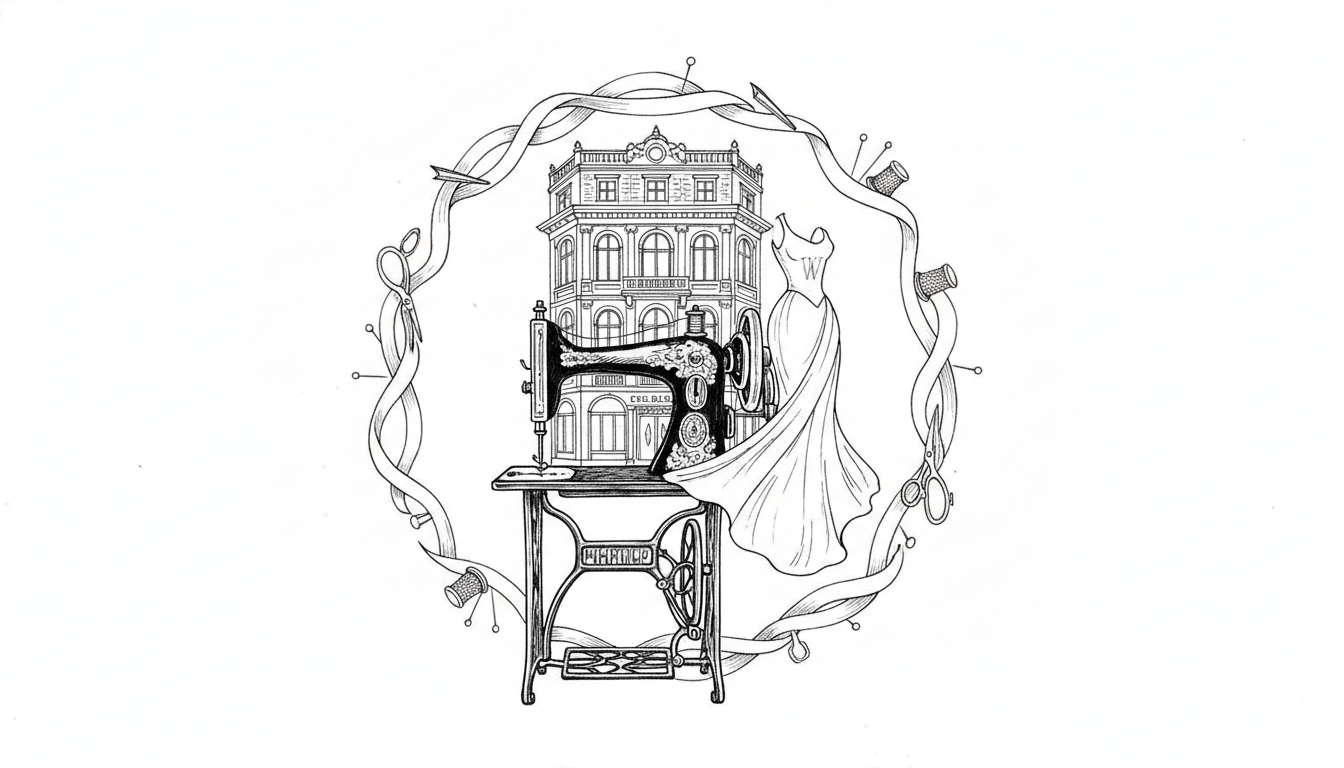
Before the Fashion House: Clothing as a Negotiated Service
Chapter 1
A dress could be fashionable long before fashion became an industry. In the older arrangement, a client described what she wanted, chose a fabric, and paid a dressmaker to turn those materials and hours of labor into one garment. The customer directed the result; the maker supplied the skill. What was missing was not craftsmanship but a system that could give design a public author, organize enough labor to reproduce it, and persuade customers to return for something new.
Mid-century Paris already contained pieces of that system. Charles Frederick Worth entered the city's textile trade through Gagelin, a firm that sold textiles, shawls, and some ready-made clothing. That commercial setting placed negotiated dressmaking alongside goods that could be displayed and purchased. The distinction would matter: a fashion house would have to do more than make excellent clothes. It would have to turn a dressmaker's work into an enterprise with creative authority, financial management, and coordinated production.
Worth took that step in 1858, after his work at Gagelin, when he established Worth and Bobergh at 7 rue de la Paix. Worth directed the artistic work; his partner, Otto Bobergh, handled finance. Their division of responsibility made the premises more than the workplace of a gifted individual. It joined design and business under one roof. Yet a house could not create a lasting market by naming its designer alone. The unresolved problem was how to make its designs, organize their construction, and give customers a reason to seek out the next one.
The Sewing Machine Solved One Part of the Problem
Chapter 2
The first obstacle was the seam itself. Hand sewing could join cloth, but a larger production system needed that joining operation to be faster and more consistent. In 1846, Elias Howe received the first United States patent for a broadly practical sewing machine. The machine combined mechanisms that produced a two-thread lockstitch, a seam made by interlocking an upper thread with a second thread on the other side of the fabric.
That mechanism mattered. As the needle carried the upper thread through the cloth, the second thread caught and locked it from below. The resulting seam was durable and repeatable, making machine construction suitable for wider garment production. Sewing-machine development therefore changed more than the speed of a familiar hand motion. It introduced a mechanical way to perform one essential operation and helped transform clothing manufacture between 1830 and 1880, when thousands of patents covered sewing machines and their parts.
But Howe's machine did not produce a complete garment. Its baster plate restricted the length of seam it could make, and it sewed only straight seams. A dress required more than lines of stitching: fabric had to be cut into pieces, those pieces had to be fitted and arranged, and the order of assembly had to follow a design. The machine improved the joining of cloth without solving the organization of the garment as a whole.
That limit kept people at the center of production. Someone still had to translate a design into pieces, adjust those pieces to bodies, and coordinate their assembly. Mechanical sewing could make a task repeatable while leaving cutting, fitting, and pattern work dependent on other knowledge and labor. It did not, by itself, create standardized sizing or ready-made clothing.
The sewing machine thus opened a route toward industrial production without completing it. Its durable straight seams supplied capacity, while garment shape and workshop coordination remained unresolved. The next question was not simply how to sew faster, but who would direct the many kinds of work required to turn a design into a product that could be offered again.
Worth Turned Design into Organized, Recurring Production
Chapter 3
Charles Frederick Worth's new enterprise answered that question by organizing production around a designer. When Worth opened his own premises in 1858, the business employed fifty staff members. That number points to a workshop dependent on coordinated labor, not a solitary dressmaker handling every stage of a client's commission. The maison joined Worth's artistic direction to Otto Bobergh's financial management and to the work of a sizable staff.
The arrangement also changed who controlled the garment's design. In the client-led system, the customer described the desired dress and the dressmaker carried out the request. Worth instead showed finished designs on live models, set prices, and placed his name visibly in the garments. He made the house a source of proposals. The customer could choose among designs presented by the couturier, while the fixed price and visible name gave creative authority a commercial form.
That authority depended on the workshop beneath it. A named design had to be rendered accurately enough for the maison to offer it as a coherent creation, even though fitting still required skilled adjustment and garments were not identical. Artistic conception and construction became distinct but connected functions: Worth directed what the house proposed, while organized labor turned those proposals into clothing.
The resulting authorship could be seen in changing garments, not only in a name. The fuller, crinolined silhouette associated with the 1860s narrowed in the early 1870s, with more of the skirt's volume drawn toward the back. A Worth gown from 1872 and related early-1870s designs show the newer form: a relatively straight, flat front and decorative drapery emphasizing the back. Materials, trims, silhouette, and construction changed together, making the house's authorship visible in an evolving object.
Worth's presentations therefore gave novelty a managed route from design to production. The fashion house could coordinate labor around a recognizable source of style and replace one visible form with another. Sewing technology had made a durable seam more repeatable; the maison made changing design repeatable as a commercial proposition. But for that proposition to matter beyond the workshop, customers needed a place where variety could be encountered without beginning with a private negotiation.
Le Bon Marché Made Clothing a Repeatable Retail Experience
Chapter 4
The fashion house had organized design and workshop labor, but it had not yet created a broad public setting for encountering goods. Le Bon Marché, a Parisian retail establishment founded in 1838 and revamped in 1852, supplied an early version of that setting. After the reorganization, it had four departments, twelve employees, and 300 square meters of floor space. Its range included varied goods such as lace, ribbons, sheets, mattresses, buttons, and umbrellas. The important change was not simply the inventory, but the way the inventory was gathered and presented.
Aristide Boucicaut changed the terms of retail by instituting fixed prices and guarantees that allowed exchanges and refunds. Advertising and a wider variety of merchandise encouraged customers to browse and compare. Instead of beginning with a private negotiation in which an object's price and possibilities emerged through conversation, a shopper could encounter goods in a common setting under conditions announced by the store.
That method addressed a different part of the fashion system from Worth's. Worth made the design house authoritative by presenting garments as the work of a named creator. Le Bon Marché made shopping more open and repeatable by placing varied merchandise before customers on common terms. The maison organized distinctive production; the department store organized the public experience of seeing and purchasing goods. Together, the practices connected specialized creation with a broader culture of consumption.
The 1852 establishment should be understood as a starting point, not as a completed mass market. Its departments, staff, floor area, and retail practices do not by themselves establish a finished system of standardized sizing, or erase the skilled fitting and organized labor that clothing still required. They do establish a new commercial logic: merchandise was gathered, displayed, advertised, and offered in a form that encouraged browsing rather than confining the transaction to one dressmaker and one client.
That logic developed within the Second Empire's economic expansion and the growth of urban middle-class consumption, conditions favorable to luxury fashion and large commercial premises. Luxury maisons addressed affluent consumers seeking prestigious goods, while department stores offered urban middle classes a more public and comparable shopping environment. Le Bon Marché became an emblematic early French department store, a model later associated with establishments such as Printemps and Galeries Lafayette.
Its crucial contribution was not to make every garment identical. It made merchandise, and the act of choosing among it, visible and repeatable. That was the retail condition the fashion house needed in order for changing design and organized production to reach beyond an individual appointment.
The Industry Begins When Fashion Can Be Repeated
Chapter 5
The decisive change came when clothing could be encountered repeatedly rather than negotiated only once. Le Bon Marché's openly browsable, fixed-price setting converted consumption from an individually negotiated shop transaction into a repeatable department-store experience. Customers could encounter varied merchandise, compare it under common terms, and return to a commercial environment organized around continued visibility and choice.
That consequence answers how the fashion industry began. The sewing machine had made durable straight seams more repeatable, but left cutting, fitting, and pattern organization unresolved. Worth's maison had joined a named designer to a staffed workshop and made changing silhouettes part of the house's offering. Le Bon Marché connected those developments to a public retail form.
Fashion became an industry not when craft disappeared or every garment became standardized, but when design authority, coordinated production, and repeated retail exposure could reinforce one another. Clothing was no longer only a garment made for one client. It had become part of a continuing commercial process capable of presenting novelty and inviting customers to buy again.
Bibliography
- Number 1 “Standard” sewing machine - Bard Graduate Center. https://www.bgc.bard.edu/research/articles/183/number-1-standard-sewing-machine
- 1. “If I Didn’t Have My Sewing Machine . . .”: Women and Sewing-Machine Technology | A Needle, a Bobbin, a Strike: Women Needleworkers in America | Temple University Press and North Broad Press. https://temple.manifoldapp.org/read/a-needle-a-bobbin-a-strike-women-needleworkers-in-america/section/58cf4304-f294-4bc4-8480-f4fb26cc3b3a
- The History of Fashion: From Craft to Brand | Social Life Magazine. https://sociallifemagazine.com/the-archive/history-of-fashion/
- Le Bon Marché | European Fashion Heritage Association. https://fashionheritage.eu/le-bon-marche/
- French Department Stores during the Second Empire - napoleon.org. https://www.napoleon.org/en/history-of-the-two-empires/articles/french-department-stores-during-the-second-empire/
- 1872 – House of Worth, Seafoam Green Silk Gown | Fashion History Timeline. https://fashionhistory.fitnyc.edu/1872-worth-green-silk-gown/
- Worth & Paris Couture — The Cohasset Historical Society. https://www.cohassethistoricalsociety.org/ga-essays/paris-worth
- Le Bon Marché: World’s oldest department store revolutionized shopping | CNN. https://edition.cnn.com/travel/article/le-bon-marche-paris-department-store/index.html
- The British Newspaper Archive Blog Charles Frederick Worth | British Newspaper Archive. https://blog.britishnewspaperarchive.co.uk/2024/02/14/charles-frederick-worth/
- Howe Patents His Sewing Machine | History | Research Starters | EBSCO Research. https://www.ebsco.com/research-starters/history/howe-patents-his-sewing-machine