Shared article
From Clockwork Curiosities to Autonomous Agents: The Changing Meaning of Machine Life
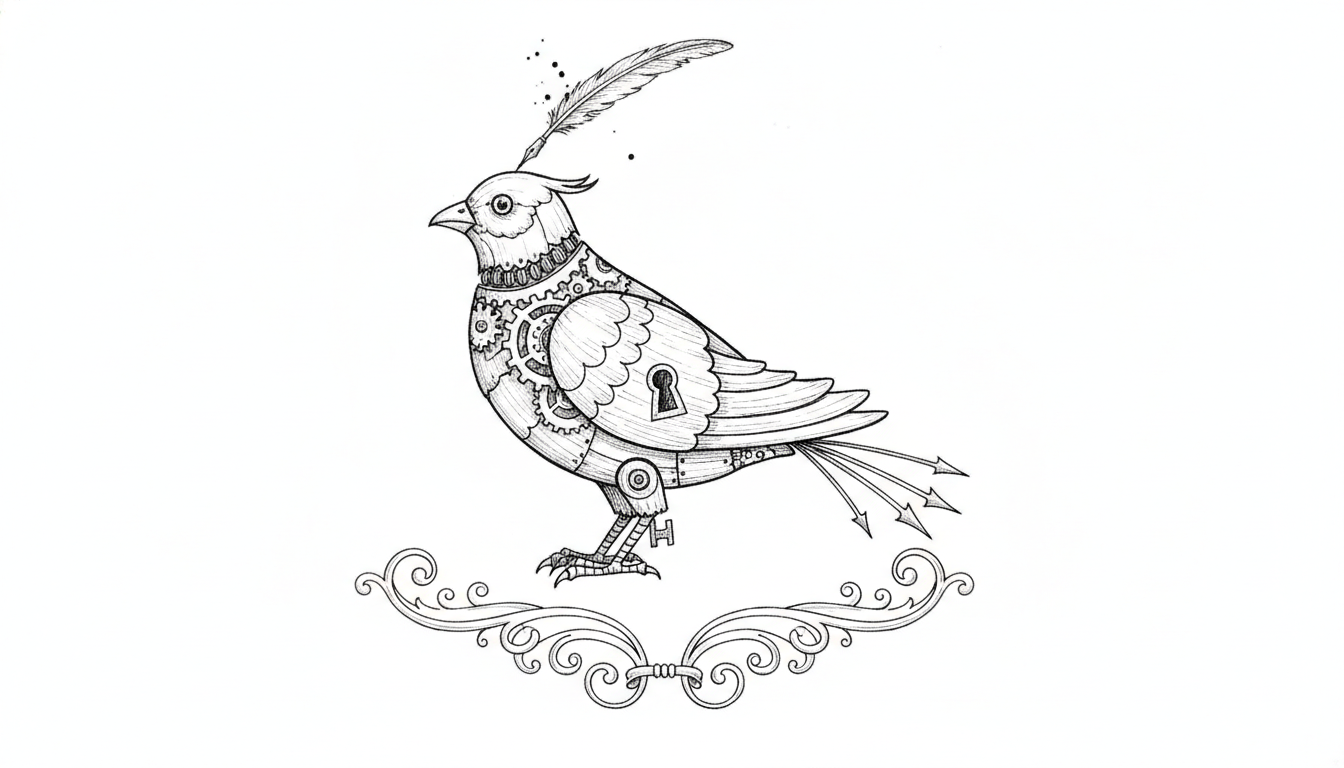
When Motion First Looked Like Life
Chapter 1
Long before a machine could navigate a warehouse or interpret an instruction, automata made one fact visible: motion can look like life.
A water clock could regulate the level of water in a vessel with floats and valves, causing another mechanism to move or trigger an action. Later, clockwork figures appeared in European cathedral clocks. Crowing cocks, kings turning sandglasses, bears shaking their heads, and the twelve apostles performed sequences that connected timekeeping with spectacle. Their apparent life came from physical causes—flowing water, falling weights, gears, cams, springs, and levers—not from an ability to understand their surroundings or revise their purposes. [C1, C2]
That distinction sits at the heart of automata. In its broad sense, an automaton is a self-operating machine. But self-operation can mean something narrow, such as repeating a stored movement, or something more flexible: sensing a situation, choosing among actions, and pursuing a goal while conditions change. A mechanical figure that moves at a fixed interval and a software agent that monitors a digital workflow are separated by centuries of engineering, but they belong to the same long effort to make activity occur without continuous human control.
Early automata were therefore more than practical devices. They were spectacles, models, and technological curiosities. They expressed a desire to simulate and understand life and cosmological processes by reproducing visible behavior. The machine’s value lay partly in what it did and partly in what its doing seemed to ask: could the characteristic activities of living things be recreated by arranging inanimate matter?
The mechanisms could be intricate, but their goals were usually fixed in advance. A clockwork bird did not decide to sing because something in its environment had changed. It enacted a sequence designed by its maker. This is the first important boundary in the history of automata: visible animation is not the same as environmental understanding.
Modern autonomous systems reverse the emphasis. Their most significant activity may be invisible: estimating state, comparing observations with a target, selecting a plan, correcting errors, or deciding that a previous assumption no longer holds. The machine may look less like an animal than an early automaton did, yet behave more flexibly because its actions depend on information about the world.
From Stored Motion to Conditional Action
Chapter 2
The simplest way to distinguish a pre-programmed automaton from an autonomous system is to ask whether the machine checks the world before deciding what to do.
An open-loop mechanism issues predetermined commands without measuring whether its actions produce the intended result. A music box plays its stored tune. A cam turns a lever according to the shape of its surface. An automated sprinkler runs on a timer, regardless of whether rain has already soaked the ground. Such systems can be highly effective when their surroundings are predictable and their tasks are repeatable. If timing, load, and environmental conditions remain within expected limits, a fixed sequence may be the most reliable and economical design.
The weakness is that an open-loop machine has no direct way to distinguish success from failure. If a component shifts, an object is missing, or an obstacle appears, the mechanism continues because nothing in its control loop tells it to do otherwise.
An autonomous machine adds that missing connection. At minimum, it combines sensors, a controller, and actuators. Sensors measure conditions inside or outside the system: position, velocity, temperature, force, distance, light, or the presence of an object. The controller processes those observations against a target, rule, or internal state. Actuators convert its commands into force or motion. The machine then changes its environment, producing new observations that may alter its next action. [C3]
This does not require sophisticated intelligence. A bumper that detects a wall and stops a motor is already using information about the situation. A wheel encoder that reports that a motor has rotated less than commanded can prompt a controller to increase drive current or revise its estimate of position. More elaborate systems combine cameras, inertial sensors, laser range finders, maps, and software models. The principle remains the same: action is conditional on measured circumstances rather than insulated from them.
Physical embodiment alone is not enough to establish autonomy. A mechanical statue may have a body but no ability to respond. Conversely, a software agent may have no physical body and still monitor a system, call tools, alter records, or initiate a workflow. The word automaton now applies to both hardware and software devices. “Robot” is often used more narrowly for an embodied machine that senses and acts in the physical world, although everyday usage is not perfectly consistent. [C3, C13]
Digital computing changed automata by moving much of their control from fixed mechanical arrangements into editable instructions. Industrial programmable logic controllers monitor inputs and execute control logic that operates machinery. More complex robots use higher-level computers and middleware to connect perception, planning, and low-level motor control. Software does not automatically make a system autonomous: a rigid script is still a rigid script, even when expressed in code. Its advantage is that conditions, models, learning systems, and multiple control layers can be combined and reconfigured more easily than cams and gears.
The decisive shift, then, is not simply from gears to transistors. It is from stored motion to conditional action. A machine becomes more autonomous as it obtains information about its situation and uses that information to select or adjust what happens next. [C4]
Feedback, Cybernetics, and the First Reactive Machines
Chapter 3
Feedback is the technical bridge between performing a sequence and responding to circumstances.
In a basic closed loop, a sensor measures the system’s actual state. A controller compares that state with a desired condition. The difference—the error—guides the next command to an actuator. A motor may be told to reach a particular position; an encoder reports where it actually is; the controller adjusts the command until the gap narrows. The same logic can regulate speed, force, temperature, distance from an obstacle, or the position of a robot’s hand against a surface. [C5]
Feedback is powerful but not magical. It can correct only errors the system can measure. A robot with accurate position sensing but no force sensing may know where its gripper is while remaining unaware that it has crushed a fragile object or failed to grasp it. Feedback also depends on the target supplied to the controller. A system can regulate itself efficiently while pursuing a poor or incomplete goal. It also adds sensors, computation, calibration, and failure modes.
Cybernetics supplied a broader vocabulary for this way of thinking. Norbert Wiener’s 1948 *Cybernetics* and W. Ross Ashby’s 1956 *Introduction to Cybernetics* treated machines and organisms as systems organized around control, communication, regulation, and goal-seeking. The framework shifted attention away from whether a device looked alive and toward how it maintained a state, responded to disturbances, and coordinated action over time. It also suggested why relatively simple components could generate complicated behavior: complexity might arise from the organization of connections and feedback rather than from a single mechanism resembling a brain. [C6]
Grey Walter’s tortoises offered a striking demonstration. Built from war-surplus parts and old alarm-clock components, the machines used two valves, two relays, two motors, two condensers, and one light or touch sensor. A light-seeking tortoise could move toward a light, turn when it encountered an obstacle, and return to a lighted charging hutch. [C7]
The machine did not possess a human-shaped body, a large symbolic program, or an obvious inner voice. Its lifelike quality came from the relationship between its sensors, its control circuit, and its surroundings. Its route depended on where the light and obstacles happened to be. Walter associated animal-like behavior with attributes including exploration, curiosity, unpredictability, goal-seeking, self-regulation, memory, and learning. The tortoises did not possess all these properties—some belonged to later experiments involving a hardware learning mechanism—but they showed that a small network of components could produce behavior observers described as life-like without copying an animal’s appearance. [C8]
The tortoises also exposed the limits of reactive autonomy. Surviving film evidence reveals variable performance: an obstacle-avoidance response failed in one sequence, and the steering mechanism appears to have been disabled during a filmed return to the charging hutch. These details do not erase the design’s significance. They show that lifelike appearance and robust competence are different achievements. A machine may respond to its world and still lack dependable models, diagnostics, and recovery strategies for unfamiliar conditions.
Reactive control is valuable when a quick response matters more than a complete model. But a machine that must pursue a distant goal needs a way to represent more than the immediate stimulus.
From Reflexes to Models and Plans
Chapter 4
Shakey, developed at the Stanford Research Institute beginning in the 1960s, marked a further transition. It combined physical sensing and movement with symbolic representation and planning. Its hardware included a camera, bump detector, range finder, drive motors, and onboard logic. Rather than simply turning away when a sensor detected an obstacle, Shakey could represent aspects of its environment, formulate a route, and construct a sequence of actions aimed at reaching a goal state. [C9]
The difference is between reacting to a present condition and reasoning about consequences. Reactive control links a current stimulus to a rapid response. Deliberative control uses a model to consider actions whose effects unfold over a longer period. A planner can ask not only, “What is touching me?” but, “Which sequence of movements will put me beside the destination?” The model may be incomplete or wrong, but it gives the system a way to organize action beyond the immediate stimulus.
Modern robots generally combine these approaches. Cameras, infrared sensors, sonar, laser range finders, inertial sensors, and position sensors provide observations at different rates and with different uncertainties. Fast controllers stabilize motors and handle immediate obstacle avoidance. Higher-level planners select paths, tasks, or destinations. Hybrid architectures allow deliberation to set goals while reactive layers respond to urgent local events. [C10]
Autonomy is therefore better understood as a range of architectures than as a single threshold of intelligence. A warehouse vehicle may independently plan a route while receiving centrally assigned tasks. A surgical robot may control motion precisely but require continuous human direction. A software agent may select and execute digital operations while remaining constrained by permissions. In each case, the meaningful question is not whether the machine moves alone, but which parts of sensing, decision, and action it can close into a loop.
This distinction also explains why industrial robots could become useful without possessing broad environmental understanding. Unimate, installed at a General Motors plant in the early 1960s, handled hot metal components. Industrial robots became practical because factories needed repeatable machines for predictable, hazardous, or monotonous work. The work cell itself reduced uncertainty: objects arrived in known locations, tools constrained possible motions, and human access could be managed. [C11]
Mobile and service robots face a different problem. They operate in warehouses, factories, public spaces, and other environments shared with people. A factory arm can prioritize repeatability in a bounded workspace. A mobile or service robot must interpret changing surroundings, avoid obstacles, convey its intentions, and account for human comfort and social rules. A geometrically collision-free route may still be unacceptable if the robot approaches too closely or accelerates without warning.
Research on human interaction with autonomous mobile robots has identified communication channels including sound, speech, light, gesture, and touch. It has also found that much of the research remains based on controlled laboratory experiments, with gaps in field studies, multiple-robot experiments, and reporting of participant characteristics. Technical movement is therefore not the same achievement as dependable social deployment. [C12]
When Automata Became Software Agents
Chapter 5
The contemporary landscape includes both embodied robots and disembodied computational agents. A robot senses and acts through a physical body whose motors, geometry, contact forces, and energy supply limit what it can do. A software agent acts through interfaces, tools, files, networks, or digital workflows. Both can monitor conditions and select actions without a person issuing every individual command. [C13]
Language models connect these two forms of automaton. A system can interpret a natural-language instruction, break it into subtasks, and choose tools. A robot can use a language model to select parameterized skills within an existing robotics stack. The language model need not replace geometric perception, mapping, localization, motion planning, or grasp control. In a reported architecture, it reasons over structured state snapshots and invokes skills supplied by the underlying robot system.
This division of labor is important. Language is useful for flexible task descriptions and high-level deliberation; specialized robotic systems are better suited to real-time control and physical geometry. A language model can select “move the container to the shelf,” but another system must determine where the container is, whether it can be grasped, how the arm should move, and whether the grasp actually succeeded.
Reported experiments on tabletop manipulation and agricultural navigation used an iterative planner-executor loop with event checks, recovery procedures, and operator intervention. The approach increased flexibility, but it did not establish dependable general-purpose agency. Physical tests showed nondeterministic suboptimal behavior, instruction-following errors, prompt sensitivity, and occasional “verbal only” failures in which the model described a solution without changing the environment. [C14]
The core difficulty is not merely that a model might produce a bad sentence. A physical agent must maintain a usable belief about a world it cannot observe completely. Sensors are noisy. Objects may be hidden or displaced. A state estimate can become stale after the robot moves, a person intervenes, or an object slips. Contact may not produce the expected force. An event outside the system’s model may change the situation while the plan is underway. Execution also takes time, and the world can change during that delay. [C15]
A plan that is logically sound in an abstract description may fail when connected to matter. “Pick up the container” presumes that the container is where the system believes it is, that its shape and grasp points are understood, that the gripper can reach it, that no object blocks the path, and that the grasp has succeeded. Generating a more fluent plan does not supply missing physical facts.
The same problem appears in social interaction. People judge a robot not only by whether it reaches a destination but also by whether its movement is understandable and safe. Trust and perceived safety depend on robot characteristics, separation distance, and communication of movement intentions. Social legibility is therefore part of autonomy, not merely a decorative interface feature. A robot that can navigate but cannot make its intentions clear may be operationally capable and socially unusable. [C17]
The Future: Calibrated Autonomy, Not Machine Responsibility
Chapter 6
The future of automata is unlikely to arrive as a single moment when machines become independently responsible beings. It is more likely to appear as a gradual expansion of delegation.
Systems will receive greater freedom where tasks are bounded, reversible, and relatively low-stakes. They may monitor systems, select among tools, navigate familiar environments, and recover from ordinary interruptions with less supervision. Where consequences are serious, autonomy will require stronger boundaries: narrowly scoped permissions, approval gates, technical hard stops, and explicit escalation paths.
That trajectory follows directly from the history. A fixed mechanical sequence worked when the world was arranged around it. Feedback made machines responsive, but only to measurable conditions. Planning allowed them to pursue modeled goals, but only within the limits of their representations. Language interfaces broadened instructions, while physical uncertainty exposed the gap between describing an action and successfully carrying it out.
The likely future is therefore calibrated autonomy rather than unlimited agency. The machine’s freedom should depend not only on what it can technically do, but also on the stakes of the task, the reversibility of its actions, the quality of its observations, and the clarity of its relationship with people. More capable planning or language generation does not by itself guarantee robust behavior outside tested or carefully structured environments. [C15]
Technical autonomy must also be separated from moral and legal agency. An agent may plan, call tools, transact, and act without constant approval. That is operational independence. It does not mean that the system owns the consequences of its decisions in a moral or legal sense. People build these systems, organizations deploy them, and institutions define the permissions under which they act. For consequential decisions, a specific human or accountable role should remain identifiable before deployment, not selected after something goes wrong. [C16]
Automata began by making motion resemble life. Their future will be judged by a harder standard: whether their actions remain reliable, intelligible, and appropriately bounded when the world refuses to follow the script. The history points toward machines that can do more on their own—but not toward responsibility that can safely be delegated to the machine itself.
Bibliography
- A literature review on safety perception and trust during human-. https://stacks.cdc.gov/view/cdc/155558/cdc_155558_DS1.pdf
- Genealogy of Artificial Beings: From Ancient Automata to Modern Robotics | Springer Nature Link. https://link.springer.com/chapter/10.1007/978-981-19-1983-1_1
- Robotic Control System: Types, Components & How They Work. https://botasys.com/post/robotic-control-system/
- Agentic AI for Robot Control: Flexible but still Fragile. https://arxiv.org/html/2602.13081v1
- The first biologically inspired robots Owen Holland. https://cse-robotics.engr.tamu.edu/dshell/cs689/papers/holland02first.pdf
- The Robotics Primer The Robotics Primer Maja J Matari´c. https://pages.ucsd.edu/~ehutchins/cogs8/mataric-primer.pdf
- Shakey the Robot. https://ai.stanford.edu/~nilsson/OnlinePubs-Nils/shakey-the-robot.pdf
- Responsible AI Means Knowing the Limits of Agent Autonomy | MIT Sloan Management Review. https://sloanreview.mit.edu/article/responsible-ai-means-knowing-the-limits-of-agent-autonomy/
- Project MUSE - A Brief History of Robots and Automata. https://muse.jhu.edu/article/175438