Shared article
Why a Star Wars Laser Pistol Needs a Ship Around It
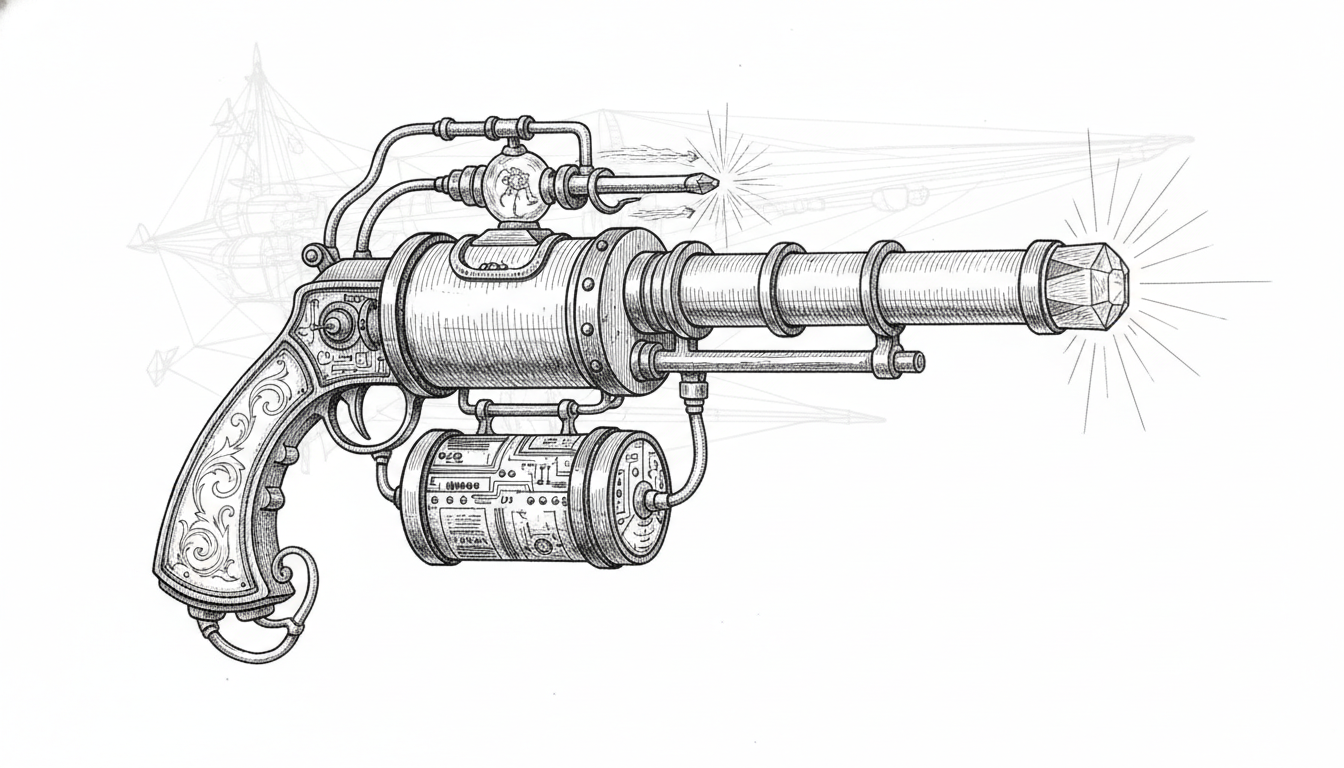
The Laser That Worked—Because It Was on a Ship
Chapter 1
A Star Wars blaster looks like a complete weapon in the most literal sense. One compact object contains its energy source, firing mechanism, aiming system, beam or projectile, and whatever prevents the assembly from overheating. Its shot crosses open air, strikes a target at useful range, and appears ready for another shot almost immediately.
Real directed-energy weapons already produce meaningful effects, but they arrange those functions differently. Their power supplies, optics, cooling equipment, sensors, and structural supports remain distributed through a ship, vehicle, or larger installation.
The U.S. Navy's Layered Laser Defense offers a useful starting point because it has done the part that sounds most like science fiction. In a demonstration described by the Office of Naval Research, an all-electric high-energy laser defeated a target representing a subsonic cruise missile in flight. The laser disabled the target by defeating its engine; the aircraft then descended, with a parachute opening as it tumbled. This was not merely a laboratory flash or a promise about future technology. It was a directed-energy system completing a useful engagement against an airborne target.
The result makes the handheld comparison sharper. Electrical energy became laser light, the light traveled through an atmosphere, and sustained energy on a vulnerable part of a moving target produced a disabling effect. But the successful shot was never just a beam. It depended on a high-power source, conversion hardware, a telescope and tracking system, and a platform able to supply and cool the weapon. HELIOS is installed on the USS Preble; the Navy's earlier LaWS system operated at about 30 kilowatts, while HELIOS is described at about 60 kilowatts.
The beam is real. The question is why the machinery that makes it useful refuses to disappear into a pistol grip and barrel.
A Glowing Plasma Bolt Is Not Automatically an Explosive Projectile
Chapter 2
Plasma is the intuitive explanation for a glowing science-fiction bolt. Physically, it is ionized gas: atoms or molecules have been stripped of some electrons, and the resulting charged particles can respond collectively to electric and magnetic fields. Plasma can be extremely hot and visibly luminous. Neither property, by itself, tells us how much useful energy a projectile contains.
The decisive distinction is energy density. A calculation for unconfined plasma at atmospheric pressure gives roughly 0.1 to 0.3 joules per cubic centimeter, depending on how the plasma's thermal and recombination energy are counted. TNT, by comparison, has an energy density of nearly 7,000 joules per cubic centimeter. These figures do not make a plasma volume and TNT interchangeable explosives, or specify a weapon's total yield. They compare the energy available per unit volume under very different physical conditions. The comparison shows why a cloud of plasma at ordinary pressure cannot automatically create the spectacular explosive effect associated with a dense charge.
Atmospheric pressure imposes the limit. A free plasma must occupy space and push against the surrounding air. If its pressure greatly exceeded the environment, it would expand; if it did not, its stored energy density would remain limited. A visible, hot volume can therefore radiate brightly while containing far less energy than its cinematic appearance suggests. Brightness is an optical outcome, not a direct measurement of destructive capacity.
A serious plasma shot would need another way to damage its target. Energy might arrive very rapidly, making the rate of deposition important. The projectile might carry substantial momentum and damage the target kinetically. Or an external beam or field might continue coupling energy into the target after the apparent bolt had left the weapon. Without one of those features, a glowing volume moving slowly through air has no automatic path to a large blast on contact.
Ballistic gel clarifies what a target model can establish. Gelatine is used in wound-ballistics research because it makes temporary and permanent wound profiles visible and comparable, providing an approximation of some effects in human tissue. It can help show how energy interacts with a material, but it does not establish a verified number of kilojoules required to disintegrate gel or produce a fictional plasma burn. The evidence establishes the plasma energy-density constraint, not a validated lethal-shot budget. The damaging mechanism must come first.
The Beam Is Only the Useful Fraction of the Power
Chapter 3
A laser changes the problem by separating the energy from the material projectile. Instead of throwing hot gas through the atmosphere, it sends electromagnetic radiation toward the target and relies on optical concentration at the point of impact. Yet the beam is only the useful fraction of the power entering the system.
Wall-plug efficiency is the ratio of optical output to total electrical input measured at the wall. A system-level accounting includes power-supply losses and the electrical demand of cooling. If a laser produces a given optical power, the rest of the input becomes heat in the power electronics, laser source, optical assembly, and thermal-management equipment. Beam output is therefore not the same as energy stored in a battery, drawn from a generator, or absorbed by the target.
The shot is a chain of conversions. Stored or generated electricity passes through power electronics; the laser source converts part of it into optical output; focusing optics direct that output toward the target. The atmosphere then determines how much arrives and how tightly it remains concentrated. The target receives only the delivered portion. Inside the weapon, conversion losses and unwanted absorption become waste heat.
The evidence does not provide a validated model for the energy needed to ablate or disintegrate a particular target, so there is no universal lethal-shot value in kilojoules to assign. The engineering conclusion does not depend on one. Every shortfall in efficiency enlarges the machinery that must supply and remove energy.
High-power laser construction makes that hidden machinery visible. Military laser diodes and diode arrays use thermally conductive copper and ceramic structures, along with cavities or pumped coolant channels. These materials and geometries provide paths for heat to leave active devices whose operation depends on staying within usable thermal conditions. The source, its mount, and its coolant path are part of the laser's function.
Pulsed operation can make a compact device appear more powerful than its continuous rating, but it does not eliminate heat. During a high-load pulse, heat accumulates in the source and surrounding structure; during a lower-load interval, the cooling system rejects some of it. That interval is recovery time, not a loophole in thermodynamics. If heat cannot be removed quickly enough, firing rate falls, optical performance changes, or the device must stop before damage occurs.
A pistol-shaped enclosure would hide this machinery, not remove it. The beam may emerge from a small aperture, but the electrical conversion and thermal path continue behind it. A handheld weapon would need a source, power conditioning, conductive structures, coolant, and a way to transfer heat into the environment without making the operator or nearby components part of the cooling system. The target sees light; the weapon must survive the remainder.
A Plasma Bolt Loses Its Laboratory
Chapter 4
The plasma alternative faces a different failure after leaving the weapon. Inside a laboratory or propulsion device, ionized gas exists within a managed geometry. Fields, electrodes, chambers, or flow paths define the conditions under which it is created and heated. A projectile in open air no longer has that same boundary.
Once released, atmospheric plasma expands into the surrounding gas and interacts with it. Collisions, mixing, and cooling erode the compact state that the weapon produced. To reach a target before dispersing, the plasma would need to travel very rapidly or receive continuous external support. A slow bolt gives its surroundings time to alter the projectile. The visible object may persist as light-emitting gas while its useful density, temperature, and ability to couple energy into a target decline.
NASA's research on recombination in magnetized plasma illustrates why the initial energy budget is more complicated than “heat the gas and fire it.” Plasma systems must actively supply energy to ionize and heat the gas. When electrons and ions recombine, the energy associated with ionization changes form; under some conditions, researchers investigate whether part of it can be recovered and reinjected as neutral kinetic energy. Recombination is therefore part of the system's energy bookkeeping, not evidence that plasma remains a permanently energized projectile.
Confinement is the central difference between a controlled plasma and a free bolt. Magnetic confinement requires field-generating hardware and a defined geometry. Those fields can organize charged particles while the plasma remains inside the apparatus that produces them. After release into air, the weapon does not carry an invisible laboratory around the projectile unless it also carries a mechanism capable of generating and sustaining that external field along the shot's path. The more the projectile depends on such support, the less it resembles a self-contained pistol round.
The familiar glow proves less than it seems to prove. Light can continue briefly as excited particles emit radiation, even while the plasma expands and exchanges energy with air. A glowing track is an observable consequence of ionization, not proof of a stable, dense, high-energy body. If the bolt is not externally supported, atmospheric dispersal limits it; if it is supported, the support system must travel, aim, and operate at the same scale as the projectile.
The Atmosphere Becomes Part of the Weapon
Chapter 5
A laser avoids the need to keep a hot gas together, but it does not travel through an empty ideal medium. The atmosphere becomes part of the engagement. A beam well formed at the emitter can arrive less concentrated, less energetic, or less stable after crossing real air.
One limitation is thermal blooming. Energy deposited along the beam path heats the air, changing its refractive properties. The altered air can spread or distort the beam, reducing the irradiance delivered to the intended point. The source may still produce the same nominal optical output, but the target receives it over a larger area or with a less favorable distribution. Source power alone therefore does not determine target effect.
Other conditions impose additional losses. Absorption removes part of the beam's energy into the intervening air, while scattering redirects some of it. Rain, fog, and humidity can worsen propagation, reducing effective range or lowering the energy that reaches the target. The practical question is whether the laser can maintain sufficient target irradiance under the conditions of a particular line of sight.
That requirement connects the atmosphere to the targeting chain. A real laser engagement must detect and track the target, focus the beam, maintain aim, and apply energy long enough to damage or disable it. The Navy's Layered Laser Defense was described as including a high-resolution telescope for tracking incoming air threats, combat identification, and battle-damage assessment. The laser is consequently not an isolated light source. It is the effect-producing part of a sensor-to-effect system, and that system must hold its aim while the target moves and the air changes the beam.
The same coupling appears inside the platform. A weapon's usable magazine depth depends on more than the number of times its trigger can be actuated. HELIOS can maintain its firing capacity only while sufficient electrical power and cooling remain available. A high-power pulse adds heat; repeated engagements add it faster than the surroundings may accept it. Practical firing capacity is therefore constrained by the rate at which the platform can reject accumulated waste heat, just as range is constrained by propagation through the air.
Atmospheric lasers are not impossible. They are useful precisely because a larger platform can coordinate optical power, beam quality, weather tolerance, sensors, tracking, and thermal recovery. A small pistol would have to perform all those tasks without the volume normally available for its supporting subsystems. Its apparent simplicity would be purchased by ignoring the air between weapon and target, the time required to hold the beam on a vulnerable point, or the heat left behind after the shot.
The Missing Component Is the Platform
Chapter 6
The ship-based demonstration makes the apparent contradiction precise. A real laser can defeat a representative airborne target, yet that result is not a blueprint for a handheld Star Wars pistol. It shows that directed energy can produce a useful effect when the weapon is treated as an integrated system rather than as an emitter alone.
The necessary logistics are distributed. Electrical generation supplies the input. Power electronics convert it. The laser source produces the optical fraction. Optics and tracking place that fraction on a moving target. Air absorbs, scatters, and refracts part of the beam, so the system must preserve enough concentration for long enough to matter. Cooling structures and pumped coolant remove the energy that conversion did not place in the beam. Sensors, aiming hardware, and battle-damage assessment complete the engagement.
The plasma version does not escape this accounting. An open-air bolt is constrained by atmospheric pressure, expands into surrounding air, and loses the controlled conditions that made it plasma inside the apparatus. To remain coherent and damaging, it needs rapid delivery, kinetic impact, or continuing external confinement. Those requirements either change the projectile into something other than the cinematic bolt or add more machinery to the weapon.
That is why the missing component is the platform. Naval lasers remain ship-integrated systems because a ship can provide electrical power, cooling capacity, sensors, structural volume, and the endurance needed for repeated engagements. A vehicle can distribute those functions through a dedicated subsystem. A pistol can imitate the shape of an output aperture or create a brief flash, but real physics keeps the useful directed-energy weapon larger than its visible muzzle.
The fictional object compresses power source, conversion, target coupling, atmospheric delivery, thermal rejection, and repeat fire into one compact package. The demonstrated weapon succeeds by doing the opposite: it distributes those jobs across a platform capable of sustaining them. The beam is real. The handheld package is the part the supporting physics will not let disappear.
Bibliography
- Plasma Guns - Galactic Library. https://www.galacticlibrary.net/wiki/Plasma_Guns
- US Navy conducts first-ever laser weapon test on an aircraft carrier to counter drone threats at sea. https://www.armyrecognition.com/news/navy-news/2026/us-navy-conducts-first-ever-laser-weapon-test-on-an-aircraft-carrier-to-counter-drone-threats-at-sea
- Military Laser Weapons: Every System in Service and What They Can Actually Do. https://militarymachine.com/military-laser-weapons-directed-energy
- Investigation of Recombination Processes In A Magnetized Plasma - NASA Technical Reports Server (NTRS). https://ntrs.nasa.gov/citations/20020067575
- The use of gelatine in wound ballistics research | International Journal of Legal Medicine | Springer Nature Link. https://link.springer.com/article/10.1007/s00414-018-1831-7
- USS Preble Used HELIOS Laser To Zap Four Drones In Expanding Testing. https://www.twz.com/sea/uss-preble-used-helios-laser-to-zap-four-drones-in-expanding-testing
- Taming the Thermal Behavior of Solid-State Military Lasers - Mobility Engineering Technology. https://www.mobilityengineeringtech.com/component/content/article/29082-taming-the-thermal-behavior-of-solid-state-military-lasers
- Wall-plug Efficiency – electrical-to-optical, all-solid-state lasers. https://www.rp-photonics.com/wall_plug_efficiency.html
- laser weapon system: Topics by Science.gov. https://www.science.gov/topicpages/l/laser+weapon+system
- Laser Trailblazer: Navy Conducts Historic Test of New Laser Weapon System | Office of Naval Research. https://www.onr.navy.mil/media-center/news-releases/laser-trailblazer-navy-conducts-historic-test-new-laser-weapon-system